Showing posts with label ineffective assistance of counsel. Show all posts

Monday, April 23, 2018

Dissent offers guidance on standard for entitlement to evidentiary hearing on IAC claim

Brown v. United States (decided March 29, 2018).

Players: Chief Judge Blackburne-Rigsby, Associate Judge Glickman, Senior Judge Nebeker.  Opinion for the court by Judge Nebeker.  Dissent by Judge Glickman.  Cecily E. Baskir for Appellant.  Trial judge: Ann O’Regan Keary.

Facts: The story of this appeal began in 1997, when Appellant was convicted of first-degree murder.  Fast forward to 2008.  That year, while serving his sentence at a federal penitentiary in California, Appellant attempted to stab a correctional officer.  Appellant’s federal public defender had him evaluated by a psychiatrist, who testified at his 2010 trial.  In the opinion of the psychiatrist, Appellant suffers from PTSD stemming from a 1991 shooting.  As a result of this condition, according to the psychiatrist, Appellant was unable to appreciate the wrongfulness of his actions at the time of the assault. After a mistrial, the 2008 charge was eventually dismissed.  Appellant then sought to attack his 1997 conviction, arguing that his trial counsel was ineffective for failing to investigate Appellant’s mental condition.  Appellant noted that he had told his lawyer about the 1991 incident that was the cause of his PTSD.  Appellant also pointed out that he had no history of violence before the 1991 incident and no motive to shoot the decedent in the 1997 incident.  The trial court denied Appellant’s ineffective-assistance-of -counsel motion without a hearing, reasoning that Appellant had failed to present any evidence to explain why he had failed to raise this claim during his direct appeal.  

Issue: Were trial counsel in the 1990s ineffective for failing to investigate a possible insanity defense, and was appellate counsel ineffective for failing to raise this issue in the direct appeal?   Holding:  No.  There were no observable symptoms or statements from Appellant that could reasonably have called attention to the possibility of an insanity defense at the time of Appellant’s trial.  Appellant therefore failed (1) to show that his trial counsel was ineffective for failing to investigate Appellant’s mental condition and (2) to show cause for the delay in bringing this claim.

Of Note: The DCCA focuses on whether Appellant established that his trial counsel was ineffective and whether the ineffectiveness was the cause of Appellant’s failure to raise this claim in a timely manner.  The basis for the Court’s reasoning is specific to the unique facts of this case.  Judge Glickman’s dissent, however, could be more broadly applicable.  Judge Glickman focuses on the narrower (and arguably more germane) question of whether Appellant was entitled to an evidentiary hearing and appointment of counsel on his claim.   
  • As Judge Glickman notes, there is a “strong statutory presumption in favor of holding a hearing.”  All that Appellant was required to do was proffer sufficient facts to show that, with an attorney’s help, he may be able to overcome the procedural bar and demonstrate that his trial counsel was ineffective.   
  • The extent of the trial court’s discretion on whether to hold an evidentiary hearing on a § 23-110 claim is “quite narrow.” Slip op. at 15 (quoting Bellinger v. United States, 127 A.3d 505, 514-15 (D.C. 2015)).  The court “shall” grant a hearing “[u]nless the motion and files and records of the case conclusively show that the prisoner is entitled to no relief.”  Id. (quoting D.C. Code § 23-110(c) (emphasis added by J. Glickman).   
  • The Court has “declared repeatedly that ‘any question regarding the appropriateness of a hearing on a § 23-110(c) motion should be resolved in favor of holding a hearing[.].’” Slip op. at 15-16 (quoting Newman v. United States, 705 A.2d 246, 261 (D.C. 1997)).   
  • In addition, “in reviewing a summary denial, we must be satisfied that under no circumstances could the petitioner establish facts warranting relief.”  Slip op. at 16 (quoting Bellinger, 127 A.3d at 515).  
  •  In Judge Glickman’s view, Appellant’s proffer was sufficient to require an evidentiary hearing and appointment of counsel.  Appellant claimed that a mental health examination would have revealed that he suffered from mental illness and could have mounted a meritorious insanity defense, and that the basis for this claim (the expert opinion from his 2010 federal trial) was not available until long after the conclusion of his direct appeal.  On the present record, there was not sufficient evidence to determine that Appellant knew or should have known that he had a mental disorder before his 2008 evaluation.  In Judge Glickman’s view, it was therefore premature of the trial court to deny this pro se motion without an evidentiary hearing.  NG

Friday, March 9, 2018

The DCCA holds that whether trial counsel would have presented suppressed, favorable evidence is irrelevant under Brady, but finds no Brady violation on the facts presented.


Andrews v. United States (decided February 22, 2018)

Players: Chief Judge Blackburne-Rigsby, Senior Judges Washington and Steadman. Opinion by Senior Judge Washington. Michael S. Bailey, Donald P. Salzman, and Michael A. McIntosh for Mr. Andrews. Trial Judge: Ronna Lee Beck.

Facts: Appellant and his co-defendant Mack were convicted for murder of Deyon Rivers after a joint trial at which Morris Jones was the key eyewitness. Jones testified that shortly before the murder, appellant’s friend, David Braddy, told appellant and Mack that Rivers had nearly hit Braddy’s girlfriend with a bottle rocket. Jones testified that he later accompanied Braddy to smoke marijuana and drink on Braddy’s porch and that after Braddy went inside to answer the phone, Rivers drove by and stopped at nearby corner. According to Jones, appellant and Mack then emerged from an alley and shot into Rivers’ car.

At trial, Jones was the only witness who placed appellant at the crime scene. The government also presented evidence that police found a magazine from the likely murder weapon under the driver’s seat of a burgundy Cadillac, which also contained several items belonging to appellant—e.g., medical prescriptions, traffic citations, and a vodka bottle—as well as some that did not, including a hotel receipt for Octavian Brown. Jones testified that appellant confessed to the shooting the day after it happened.

The government did not call David Braddy to testify and disclosed only limited parts of his statements to police and the grand jury—specifically, his statement, contrary to Jones’ account, that Braddy had been home alone the night of the shooting. Neither appellant nor Mack called Braddy at trial, in part because he refused to speak with defense counsel. Mack called David Braddy’s father, James, who testified that he had not seen Jones on the porch after the shooting.

Before Mack’s retrial on the same charges, the government disclosed additional statements by David Braddy, which further contradicted that Jones had been at the house near the time of the shooting or at the fireworks incident. At the retrial, Braddy testified, and the court declared a mistrial after the jury was unable to return a verdict.

Appellant moved for a new trial, arguing that the government violated Brady by failing to disclose David Braddy’s prior statements and that conflicts of interest with respect to Octavian Brown and another potential alternate suspect, Kevin Bellinger, deprived him of his right to counsel. The trial court denied both claims. Regarding the Brady claim, it ruled that David Braddy’s statements were not material, in part because the court found incredible trial counsel’s testimony that she would have called him as a witness. The trial court ruled that counsel’s representation of Brown and Bellinger did not violate the Sixth Amendment because her relationship with Bellinger did not meaningfully begin until after appellant’s conviction and there was insufficient evidence connecting Brown or Bellinger to the murder.

Issue 1: Did the government violate Brady by failing to disclose David Braddy’s videotaped interview and grand jury testimony?

Holding 1:  No. A Brady violation requires suppression, favorability, and materiality. The trial court erred by taking into account whether counsel “would have actually used the suppressed Brady evidence,” which is “irrelevant once evidence is found to be favorable and suppressed.” A court may appropriately recognize “the benefits and potential disadvantages of suppressed evidence,” but should proceed “directly” to assessment of materiality “in light of the entire record, without speculat[ing] as to the defense counsel’s actual use of that evidence and without making a finding as to trial counsel’s credibility.”

Nevertheless, David Braddy’s suppressed statements were not material because they were in part cumulative of James Braddy’s testimony and largely went to impeach Jones, who was significantly impeached at trial, and further because the statements were in part harmful to appellant, in that David had said that appellant carried a gun and drove the Cadillac where the magazine from the murder weapon was found and that his father had seen appellant running from the scene of the shooting after it happened. Neither David Braddy’s testimony at Mack’s retrial nor the outcome of that retrial change this conclusion, in light of the differences in the respective cases against Mack and appellant.

Issue 2: Did trial counsel’s relationships with Brown and Bellinger create conflicts of interest that violated appellant’s right to counsel?

Holding 2: No. Notwithstanding any conflict, appellant failed to show that he was prejudiced by counsel’s failure to pursue Brown and Bellinger as alternate suspects because there was insufficient evidence to establish that they had the requisite “practical opportunity to commit the crime.” See Winfield v. United States, 676 A.2d 1 (D.C. 1996) (en banc). Thus, counsel would not have been able to present Brown and Bellinger as alternate suspects.—WC

Read the full opinion here.

Wednesday, March 7, 2018

Multiple Shootings, Mutliple Defendants, Multiple Issues Leads to Affirmance in South Capitol Street Case


Bost et al. v. United States (decided February 15, 2018)

Players: Chief Judge Blackburne-Rigsby, Associate Judge Fisher, and Senior Judge Ferren. Opinion by Chief Judge Blackburne-Rigsby. Kristina A. Crooks for Mr. Bost. E. Benton Keatley, Jeffrey T. Green, Lowell J. Schiller, Karen S. Smith, and Blair J. Greenwald for Mr. Best. Thomas T. Heslep for Mr. Williams. PDS for Mr. S. Carter. R. Trent McCotter, Jessie K. Liu, and Michael W. Khoo for Mr. O. Carter. Trial Judge: Ronna Lee Beck.

Facts: The Carter brothers (Sanquan and Orlando), along with Best, shot and killed Jordan Howe on Alabama Avenue in retaliation for the suspected theft of Sanquan’s bracelet. Sanquan was arrested shortly after that shooting and played no role in subsequent events. The following day, a group of Howe’s associates shot and wounded Orlando. In retaliation for that, Bost, Orlando, Best, and Williams planned to attack Howe’s funeral. The group first planned to rob Tavon Nelson for his gun. Best and Bost carried out the robbery, which turned into a shootout that left Nelson dead. The group then did a drive-by shooting of a house on South Capitol Street where Howe’s friends had gathered after the funeral, leaving three dead and several wounded.

Issue 1: Should Sanquan’s case have been tried separately from the others on the ground that he was charged in connection with only the Alabama Avenue shooting? Same as to Bost, who was charged in only the South Capitol Street shooting?

Holding 1: No. Although the issue was not “an easy one,” the charges from the Alabama Avenue and South Capitol Street shootings were properly joined under Super. Ct. Crim. R. 8(b) as part of “the same series of acts or transactions.” Although there was an intervening event — the shooting of Orlando — between the Alabama Avenue and South Capitol Street shootings, there was still a causal connection between them, which is sufficient to make the latter a “sequel” to the first crime. The DCCA rejected the government’s alternative argument that the two shootings were part of a “common scheme or plan.”

Severance was not required to prevent prejudice from the presentation of evidence as to the shootings in which Sanquan and Bost were not involved. Because both were “active participants in conspiracies to commit first-degree murder,” their complicity in the overall venture is not “de minimis.” The evidence was not “so complex or confusing that the jury could not make individual determinations about the guilt or innocence of each defendant.” And “the trial court made efforts to ensure that the jury was not confused about the charges,” by reminding the jury that Sanquan and Bost were not charged with certain offenses, instructing the jury that certain statements could not be used against one or the other, and giving a “strongly worded curative instruction,” in response to the prosecutor’s rebuttal argument, that Sanquan had no responsibility for the South Capitol Street shooting.

Issue 2: Was there a risk of a coerced verdict because a juror reported “pressure from many members of the group to change my mind regarding my vote on particular counts on which we disagree”?

Holding 2: No. The potential of coercion from the note was low, because the juror did not report pressure from the entire group, or that they disagreed on all counts. The identity of the juror was not revealed in open court, “making it less likely that the juror felt undue pressure from the rest of the jury.” The exact division of the jury was (theoretically) unknown. No verdict had been announced, and the court did not give an anti-deadlock instruction. The note did not report any improper behavior during deliberations, only that they were “spirited.” Because the coercive potential was low, the trial court appropriately gave a “neutral, even ‘bland,’ instruction” in response, asking them to resume deliberations and remain civil. An anti-deadlock instruction would have been premature “as there was no indication that the jury was deadlocked at the time of the note.”

Issue 3: Was Best’s trial counsel ineffective for failing to move to suppress Best’s videotaped interrogation on Miranda grounds?

Holding 3: No. Best’s attorney reasonably believed that the factual allegations supporting the motion suppress “were not true.” In addition, the motion to suppress would have been futile because the incriminating portions of the video came in response to questioning by Best’s mother, not police.

Issue 4: Was a mistrial required due to the prosecutor’s conduct during opening — referencing the “Equal Justice Under Law” inscription on the Supreme Court building; asserting that the government’s role was to “fairly enforc[e] the criminal laws”; and decrying “vigilante justice” — and closing — characterizing certain government witnesses as “heroes,” one of whom was doing “God’s work”; asserting that the jury should be “proud” of the police investigation; presenting a blown-up photo of a murder victim that elicited an emotional response in the courtroom; and pleading that the victims’ families were asking for “justice” rather than vengeance?

Holding 4: No. The prosecutor’s comments during opening statement “did not appear to cross the line of permissible opening statements, as the comments were not argumentative.” Even if they were improper, they were “not so grave as to warrant a mistrial.” The trial court’s curative instruction after the openings to base their verdicts on evidence rather than emotion was an appropriate response.

The prosecutor’s statements in closing that the jury should be proud of the police and characterizing certain witnesses as heroes were “not improper when considered in context.” These statements did not “urge the jurors to place themselves ‘in the position of the victim,’ nor did the statements rise to the level of an appeal ‘to the jury’s emotions.’” The prosecutor’s comment about the families asking for justice rather than vengeance “may have appealed to the sympathy of the jurors,” but did not rise to the level of improperly “asking the jurors to ‘send a message to the defendant[s]’ or to the community with their verdicts.” The use of the photograph was not improper because it was admitted into evidence.

Issue 5: Should the trial court have instructed the jury on withdrawal from a conspiracy because Williams left the vehicle before the South Capitol Street shooting, saying, “Y’all about to go commence. Y’all can let me out right here”?

Holding 5: No. To withdraw from a conspiracy, one must act to “disavow” or “defeat the purpose” of the conspiracy. Simply leaving the scene is insufficient to establish withdrawal.

Of Note:
  • The DCCA rejected an argument based on a malfunctioning courtroom “husher,” reasoning that there was no evidence any of the jurors actually overheard any of the bench conferences.
  • The DCCA also rejected an argument for a change of venue due to adverse pretrial publicity because a change of venue is generally unavailable in Superior Court, and the jurors empanelled had not been influenced by media reports on the case. 
  • The DCCA held that Best’s non-verbal “confession” to his mother, and a verbal confession to a friend, were properly admitted as statements against penal interest. 
  • The DCCA rejected a number of other issues summarily. Although the court “question[ed] whether the government needed to present testimony from four mothers of the victims,” it ruled that this did not show that the jury decided the case based on emotion. The court held the trial judge did not improperly curtail cross-examination of a cooperating witness. And the court held that the trial court did not err in precluding evidence that the cooperator fired a gun in 2007. DG
Read the full opinion here.

Wednesday, October 25, 2017

Apartment dweller’s sworn statement that government witness could not have seen murder from dweller’s apartment window requires evidentiary hearing in IAC case, despite lack of further detail


Bethea v. United States (decided Sept. 28, 2017)

Players: Associate Judges Glickman, Thompson, and Easterly. Opinion by Judge Easterly. Dissenting Opinion by Judge Thompson. Richard S. Stolker for the appellant. Trial Judge Craig Iscoe.

Facts: In February 2002, a jury convicted appellant of several counts related to a September 21, 1998 murder. The government’s case relied on a single, drug-addicted eyewitness, who testified (after being arrested on a material witness warrant) that while looking out of a certain Mr. Norwood’s apartment window, she saw appellant fire a gun into the driver’s side window of a car.

After appellant’s conviction, but before sentencing, the trial court appointed new counsel, and appellant filed a § 23-110 motion, alleging, inter alia, that trial counsel was ineffective for failing to call Norwood as a witness. Norwood’s affidavit attested that he had been away from his apartment between 7 am and 7 pm on the day of the murder and that there was “no way physically possible for [the eyewitness] to have been in [his] residence during the hours specified.” The trial court denied appellant’s motion as unripe because sentencing had not occurred. Counsel did not attempt to resurrect the motion after sentencing, and a different attorney was appointed for appeal.

In 2009, while appeal was still pending, appellate counsel successfully moved Judge Iscoe, to whom the case had been transferred, to “adopt” the previously dismissed § 23-110 motion and to stay the proceedings “pending further investigation and the possible filing of a supplement to the ineffective assistance motion.” Appellate counsel filed no motion to supplement or lift the stay, before Judge Iscoe reinstated appellant’s original post-trial attorney.

In August 2015, appellant’s original post-trial attorney filed a second § 23-110 motion, again alleging trial counsel’s ineffectiveness in failing to call Norwood as a witness.  Judge Iscoe denied this motion without a hearing, finding, based on Norwood’s affidavit, that Norwood’s testimony would be too lacking in detail about Norwood’s basis of knowledge to warrant relief.

Issue: Did the reviewing court abuse its discretion by denying appellant’s IAC claim without a hearing, based on the finding that Norwood’s proposed testimony was too lacking in detail to warrant relief?

Holding: Yes. Appellant was entitled to an evidentiary hearing, unless there was “no circumstance under which [he] could establish facts that warrant relief.” Although this exception is triggered by claims that, “even if true, do not entitle the movant to relief,” that conclusion is not warranted here.

Norwood’s affidavit was not devoid of detail. Assuming it covered the time period when the murder occurred, his statement that it was impossible for the eyewitness to have been in his apartment fairly implied that he left his apartment and locked the door and that the witness had no way of getting in, as far as he knew.

Moreover, the reviewing court failed to consider that Norwood could have expanded on the affidavit at a hearing. By assessing appellant’s underlying IAC claim in light of mere assumptions about Norwood’s testimony, the reviewing court conflated the procedural question of whether there was some reason to deny a hearing with the distinct merits question of whether the claim warranted relief (after any questions of fact were properly resolved).

Under the appropriate standard, appellant was entitled to a hearing because the record does not show his inability to “establish facts warranting relief.” Rather, Norwood’s affidavit “alleged specific facts that indicate that counsel provided ineffective assistance by failing to call a witness who could have testified that the government’s sole eyewitness to the murder could not have seen what she said she saw.”

Judge Thompson dissents.

Of Note: 

  • In a footnote, the Court clarified that while a § 23-110 motion may also be denied without a hearing when it raises claims that “are vague and conclusory,” the trial court neither relied upon that ground to deny appellant’s motion, nor could have relied upon it, given that the motion “clearly state[d] the basis of his claim—[IAC]—and the manner in which [appellant] believes trial counsel provided that ineffective assistance.”
  • Although appellant’s attorneys failed to supplement his IAC claim after his appellate attorney sought leave to do so, the Court was unwilling to infer that they thought doing so was necessary to obtain a hearing or that they had been, or would be, unable to do so. WC

Tuesday, August 15, 2017

Failure to Advise MPD Officer of Potential Employment Consequences of His Testimony Was Not Ineffective Assistance


Turner v. United States (decided August 10, 2017)

Players: Chief Judge Blackburne-Rigsby, Associate Judge McLeese, and Senior Judge Reid. Opinion by  Judge Reid. Nigel A. Barrella for Mr. Turner. Trial Judge: Robert E. Morin.

Facts: Turner, an officer with the Metropolitan Police Department (MPD), was convicted after a bench trial of simple assault based on an excessive force incident. Turner testified in his defense, but the trial judge concluded that his testimony was "not credible" and found him guilty of the assault. MPD filed disciplinary charges against Turner based on the assault, but a panel of MPD officers reasonably doubted that Turner was guilty (despite the conviction), and recommended that he be returned to full duty. However, the U.S. Attorney's Office later informed MPD that it would no longer sponsor Turner's testimony in future cases due to the adverse credibility finding made against him. Based on that, MPD amended the disciplinary charges against Turner, and he was fired.

Turner challenged his conviction on the basis of ineffective assistance of counsel, arguing that his trial attorney should have informed him of the adverse employment consequences that could flow from his decision to testify in his criminal trial. The trial court denied the claim.

Issue: Was trial counsel's failure to advise a defendant of potential adverse employment consequences that could result from his decision to testify constitutionally deficient performance?

Holding: No. Although the Supreme Court has held that an attorney must advise a defendant of the potential immigration consequences of a criminal case, that ruling does not extend to potential employment consequences. Unlike immigration cases, where deportation is "intimately related to the criminal process," Turner's loss of his job did not flow directly or automatically from his criminal case. Moreover, while immigration consequences can be determined from reviewing the pertinent statutes, an attorney would have "to jump through several speculative hoops" to advise Turner of the employment consequences from his decision to testify and a finding that his testimony was not credible.

Of Note: Because the DCCA found there was no deficient performance, it did not reach the issue of prejudice.  It did, however, note that the prejudice inquiry would present difficulties for Turner. He did not contend that the result of his trial might have been different had he not testified, and the DCCA saw no way it could "erase the trial court's finding that [Turner's] testimony was not credible," so that there was no basis for the court to eliminate the grounds for his termination.

DG

Read the full opinion here.

Tuesday, November 15, 2016

The Lesser Known Writ of Error Coram Nobis Is The Proper Vehicle For Ineffective Assistance Of Counsel Claims If No Longer Detained


Surur Fatumabahirtu v. United States (decided November 3, 2016). 

Players: Associate Judges Glickman and Beckwith, Senior Judge Ferren.  Opinion by Judge Beckwith.  Jeffrey Light for Ms. Surur (the case caption incorrectly switches Ms. Surur’s given and family names).  Trial Judge: Wendell P. Gardner.

Facts: Ms. Surur was convicted of attempted possession of drug paraphernalia with intent to sell, which was affirmed on appeal.  See Fatumabahirtu v. United States, 26 A.3d 322 (D.C. 2011). Ms. Surur was working as a clerk at a gas station where she was alleged to have sold an ink pen along with a copper scouring pad to an undercover officer. The officer testified that he only asked for a pen, and that when the clerk sold him the pen along with the scouring pad, she did so because the two items are often used together to make crack pipes.

Ms. Surur filed a petition for writ of error coram nobis, alleging ineffective assistance of trial counsel. Ms. Surur particularly took issue with the fact that counsel did not pursue a misidentification defense.  Ms. Surur did not precisely fit the description of the clerk that the officer provided, she had testified that she had never seen the officer before, and had said that another clerk matched the officer’s description more closely.

At the hearing, trial counsel testified that he did not pursue a misidentification defense not for strategic reasons, but because he “just went with a different defense.”

Issues: Was trial counsel ineffective for not investigating a misidentification defense? And is a writ of error coram nobis the appropriate vehicle for relief?

Holding: Yes and yes. Counsel’s performance was deficient under the Strickland ineffectiveness test. The Court acknowledged that there are “strategic and tactical” reasons to pursue certain defenses to which the Court defers, but here, “the issue in evaluating counsel’s performance is not the reasonableness of the strategy counsel ultimately pursued,” “but the reasonableness of the investigation said to support that strategy.” (quoting Cosio v. United States, 927 A.2d 1106, 1126 (D.C. 2007) (en banc)). The Court reasoned that “deference to counsel’s strategic choices does not come into play” because counsel “offered no strategic explanation for failing to pursue these avenues of investigation.” A misidentification defense would not have been inconsistent with the defense counsel chose, and counsel was on notice of a misidentification defense when Ms. Surur testified that she had never sold the ink pen and scouring pad yet counsel still did not ask  “basic questions,” pursue “extrinsic evidence,” or go over Ms. Surur’s testimony with her before trial—all steps that likely would have uncovered the misidentification defense. Thus, the Court held that counsel rendered constitutionally deficient performance by failing to pursue a misidentification defense. 

The Court held that Ms. Surur was prejudiced by her counsel’s deficient performance because there is a reasonable probability that the outcome of trial would have been different given (a) Ms. Surur’s testimony that she does not own the clothing that the undercover officer said the clerk was wearing; (b) the fact that Ms. Surur did not closely match the height or weight that the officer gave of the alleged clerk who sold him the paraphernalia; and (c) the other clerk who worked at the store was Ethiopian, like Ms. Surur, and similarly complexioned.

The Court also ruled that a writ of error coram nobis is the proper vehicle to pursue and ineffective assistance of counsel claim when a person is no longer in custody. To obtain coram nobis relief, “a petitioner is required to demonstrate that: (1) the trial court [was] unaware of the facts giving rise to the petition; (2) the omitted information is such that it would have prevented the sentence or judgment; (3) petitioner is able to justify the failure to provide the information; (4) the error is extrinsic to the record; and (5) the error is of the most fundamental character.” The Court held that all five factors were satisfied here. DH

Friday, July 22, 2016

Firearms Examiner May Not Testify That Bullet Was Fired From a Particular Gun With Absolute Certainty, Plus Some Other Errors, But No Harm


Eric Gardner v. United States (decided June 23, 2016)

Players: Chief Judge Washington, Associate Judge Glickman, and Senior Judge Reid. Opinion by Judge Reid. Benjamin Brooks for Mr. Gardner. Trial judge: Robert I. Richter

Facts: A taxi driver was shot and killed.  Police canvassing the area went to a nearby motel, and received a report that a man, who turned out to be Mr. Gardner, had just recently returned to room 114.  Officers standing outside the room heard a male voice saying he "need[ed] to get this stuff off of me, I'm very amped up right now," a shower running, and what one officer claimed was the distinctive sound of a gun being racked. Another officer outside the motel saw Mr. Gardner climb out of a window.  When the officer approached, Mr. Gardner dropped his jacket and a black gun, and he ran. The jacket had a blood stain, and DNA analysis could not exclude the taxi driver as one of two different contributors of the DNA.   Police later found, in an alley where a witness had seen a man running from the taxi driver's cab, a silver and black gun.  A witness claimed Mr. Gardner had shown her a silver and black gun shortly before the shooting.  A firearms examiner testified that the silver and black gun found in the alley was the gun that fired the fatal shot. A jailhouse informant testified that Mr. Gardner had admitted that he tried to rob the taxi driver and shot him when he refused to give up his money.  

Mr. Gardner testified in his defense that he had been a passenger in the taxi and was about to pay his fare when a third person with a gun attempted a robbery of the taxi.  Mr. Gardner struggled with the robber, and the driver accelerated the car, and then a shot rang out.  The robber ran off, and the taxi continued driving some distance before it crashed.  Mr. Gardner then ran to the motel, admitting that he had gone through the alley in which the silver and black gun was found.

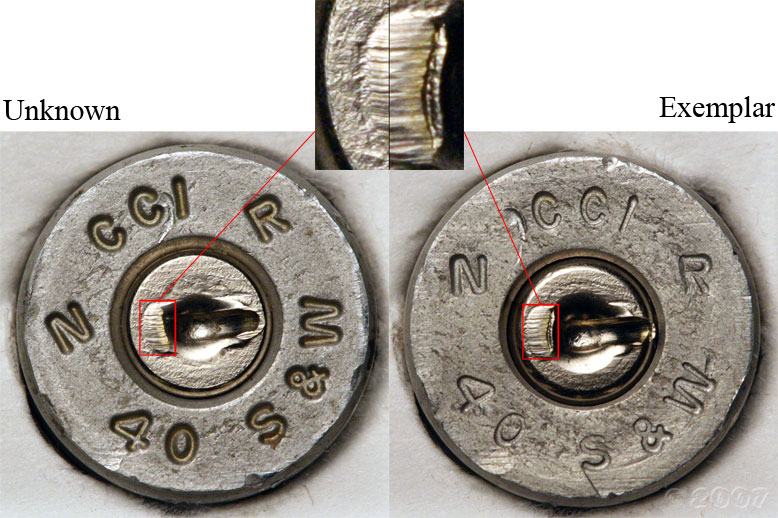
Issue 1:  May a ballistics expert testify that a bullet was fired from a specific gun with 100% certainty?

Holding 1: No.  The Court adopted Judge Easterly's position in her concurring opinion in Williams v. United States, 130 A.3d 343 (D.C. 2016), which we blogged about here, and held that "a firearms and toolmark expert may not give an unqualified opinion, or testify with absolute or 100% certainty, that based on ballistics pattern comparison matching a fatal shot was fired from one firearm, to the exclusion of all other firearms."  The Court did not preclude firearms examiners from offering an opinion that a bullet or casing came from a gun, but they cannot opine that it did with absolute certainty.  The Court also expressed "doubts as to whether trial judges in this jurisdiction should permit toolmark experts to state their opinions 'with a reasonable degree of certainty.'"

However, the Court held the error was harmless, calling the remaining evidence "strong and compelling."

Issue 2:  Did the court err in allowing a government DNA expert to testify that DNA from the silver gun matched Mr. Gardner's DNA at only two of the thirteen loci that are typically analyzed?

Holding 2:  No.  Given the low bar for evidence to be relevant, the match at only two loci was relevant even if it was not uncommon for different people to match at those locations.  The evidence was also not more prejudicial than probative, given the analyst's testimony that there was insufficient DNA to obtain a profile, and it was common for different people to match at a single locus.

Issue 3:  Did the court err in preventing Mr. Gardner from testifying about his knowledge that the jailhouse informant had a reputation as a "snitch," allowing the defense to argue that Mr. Gardner would not have confessed to a known snitch?

Holding 3:  Assuming this was error, it was harmless.  The informant had admitted during cross-examination that he was a known snitch, and his credibility was otherwise substantially impeached.  Mr. Gardner's testimony that he know of the informant's reputation "would have been, at most, a small addition to the impeachment of [the witness], and not a significant contribution to enhancing Mr. Gardner’s own credibility."

Issue 4:  Did the court err in refusing to give a "plea agreement" instruction, cautioning the jury that testimony of a witness who has entered into a plea agreement should be considered with caution?

Holding 4:  No, because the informant did not have a plea agreement with the government.

Issue 5:  Did the court err in restricting the defense's cross-examination of a police officer about two investigations targeting the officer, one for harassment and the other for excessive force?

Holding 5:  Assuming this was error, it was harmless.  The officer was effectively cross-examined, and his testimony was a small piece of the government's evidence.

Issue 6:  Were Mr. Gardner's post-arrest statements to police voluntary?

Holding 6:  Yes.  Although he had been held for some time, he was sleeping for the first ten hours.  Although he was not immediately given food when he asked for it, he was not told that food be withheld unless he gave a statement.  Mr. Gardner initiated his conversation with police, and he signed a waiver form.  At one point during his statement when Mr. Gardner was shivering, officers "turned the vent off."  Mr. Gardner's will was not overborne in such a way as to render his statements the product of coercion.

Issue 7:  Did trial counsel provide ineffective assistance by failing to cross-examine the firearms examiner using a specific report; failing to object to post-arrest police statements to Mr. Gardner about multiple witnesses to the shooting, and failing proffer a basis for the admissibility of Mr. Gardner's testimony about his knowledge of the jailhouse informant's reputation as a snitch?

Holding 8:  Assuming trial counsel's performance was deficient, there was no prejudice.

Of Note:

  • Although the opinion's holding bars only testimony that an expert is absolutely certain a bullet or casing came from a particular gun,the opinion leaves the door open to further limitations on the testimony of firearms examiners.  Defense attorneys should continue to fight for limits on this testimony, using the reports and articles cited in the opinion as ammunition.
  • The court's harm analysis leaves much to be desired.  The defense presented a plausible account of the shooting that the jury might have credited, particularly given the government's apparent inability to explain why Mr. Gardner's jacket had blood from two different (and unknown) individuals, and the failure of police to preserve a bloodstain on the right rear passenger window -- evidence which could have corroborated Mr. Gardner's account of a third person's presence.  The fact that the apparent murder weapon was found on Mr. Gardner's flight path and the purported confession he made to the jailhouse informant were thus critical pieces of evidence.  Given that the errors went to those aspects of the government's evidence, the finding of harmlessness from the cumulative prejudice is dubious.  DG

Read full opinion here.  


Tuesday, April 26, 2016

Counsel Was Ineffective in Failing to Consult with Client About Legal Options After Government Breach of Plea Agreement, But No Prejudice


Ralph L. Clark v. United States (decided April 21, 2016)

Players: Chief Judge Washington, Judge Thompson, and Senior Judge Ferren. Opinion by Judge Ferren. William T. Morrison for Mr. Clark. Trial judge: Ann O. Keary.

Facts: This was an appeal from the denial of a § 23-110 motion based on ineffective assistance of counsel. Mr. Clark’s conviction was previously affirmed on direct appeal. See Clark v. United States, 51 A.3d 1266 (D.C. 2012). Clark pleaded guilty to an armed robbery, and his plea agreement provided that the government agreed not to allocate for a sentence greater than 10 years. Nonetheless, in its sentencing memo, the government recommended 20 years of incarceration. The trial judge caught the error at the sentencing hearing, but went forward with the sentencing, deeming it sufficient for the government to file an amended sentencing memorandum. Defense counsel agreed to this. During allocution, however, the prosecutor argued that a ten-year sentence would be “very generous.” The trial court sentenced Mr. Clark to ten years in prison.

On appeal, Mr. Clark argued that the government had compounded its breach of the plea agreement by arguing that that a ten-year sentence would be “very generous,” and sought remand for resentencing before a different judge. The Court of Appeals found the government’s breach to be “grave and inexcusable,” but because trial counsel did not object to the allocution or to the trial judge’s decision to keep the case for sentencing instead of referring it to another judge, the Court reviewed for plain error and affirmed Mr. Clark’s conviction.

Mr. Clark then filed a §23-110 motion alleging that his plea attorney had provided ineffective assistance by deciding to continue with sentencing without consulting with Clark about the government’s breach of the plea agreement and the available remedies, including assignment to a different judge for sentencing or plea withdrawal. The sentencing judge denied the § 23-110 motion without a hearing.

Issue: Did plea counsel provide constitutionally ineffective assistance warranting reversal by failing to inform Clark about the government’s breach of the plea agreement and failing to explain his legal options in response to that breach?

Holding: No. Counsel was constitutionally deficient in failing to consult with Mr. Clark about his legal options after the government’s breach of the plea agreement, but there was no “reasonable probability that, but for counsel’s failure to advise about plea withdrawal, Clark would have sought to withdraw his plea.”

Of Note:
  • No Shepard bar. The Court noted that Clark filed his § 23-110 motion after the Court of Appeals had announced its decision in his direct appeal (Clark I), but before the Court issued its mandate. It did not recognize any procedural default pursuant to Shepard v. United States, 533 A.2d 1278 (D.C. 1987) (generally requiring ineffective assistance claims to be raised during the pendency of the direct appeal), however, because “[n]either the government nor the court raised a timeliness issue when the motion was filed, nor does the government do so in this appeal.” The opinion does observe that Clark could have “ask[ed] for a stay of the mandate in Clark I so that, if the § 23-110 motion were denied, the appeal from that denial could be consolidated with the direct appeal.”
  • The decision about how to respond to the government’s breach of the plea agreement was “for a counseled client, not the lawyer, to make, no matter how improvident a plea withdrawal would be.” MW

Friday, December 11, 2015

When Petitioner Alleges “Classic” Ineffectiveness Trial Court has Little Discretion to Deny Evidentiary Hearing


Bellingerv. United States (Decided Nov. 25, 2015)

Players: Chief Judge Washington, Associate Judge Glickman, and Senior Judge Farrell. Opinion by Judge Glickman; concurrence by Judge Farrell. Michael J. Anstett and Douglas W. Baruch for Mr. Bellinger. Trial Judge: Russell F. Canan.

Facts: Mr. Bellinger was convicted, after two mistrials in which the jury hung, of assault with intent to kill against Lorraine Jackson. The government’s theory was that Mr. Bellinger had shot Ms. Jackson in retaliation for acting as a police informant. At trial, Mr. Bellinger had presented an alibi defense. After his first trial, counsel for Mr. Bellinger, the Public Defender Service (PDS), moved to withdraw based on a conflict of interest, and Phyllis Baron then represented Mr. Bellinger in the two subsequent trials.

Again, new counsel was appointed for sentencing, and that counsel filed a motion with the trial court alleging that the basis for PDS’s withdrawal was that the defense had learned that the gun used to assault Ms. Jackson matched a gun used a few weeks later in a murder with which another PDS client, Randall Mack, was charged. The trial court ordered that the ballistics evidence from the two incidents be provided to a defense expert, and after years of litigation, a defense expert reported that shell casings recovered in the Jackson shooting matched the gun seized from Mack.

Mr. Bellinger filed a motion for a new trial under D.C. Code §23-110 (five years after receiving the expert report), arguing that Ms. Barron had been ineffective for failing to investigate the ballistics match and use it to present a third-party-perpetrator defense. Mr. Bellinger stated in an affidavit that (1) prior to his second trial, Ms. Barron told him that she had information that a gun connected to the Mack case would be linked to his case; (2) that she would investigate the issue further; (3) that neither Barron nor her investigator pursued any investigation into the issue; and (4) that Barron falsely told him that the prosecutor had refused to turn over any ballistic evidence and the court had denied her requests for ballistics discovery.

Mr. Bellinger also argued that the government had violated its obligations under Brady v. Maryland, 373 U.S. 83 (1963), by failing to turn over information linking the ballistics in the two cases.

Issue 1: Did the trial court abuse its discretion in summarily denying Mr. Bellinger’s ineffective assistance of counsel claim without first holding an evidentiary hearing?

Holding: Yes. A trial court can only deny an evidentiary hearing where a petitioner’s claims are (1) palpably incredible; (2) vague or conclusory; or (3) would not entitle the petitioner to relief. Here, if true, the facts alleged by Mr. Bellinger would be a “classic form of constitutionally deficient performance.”

In so concluding, the DCCA made three important points: First, the trial court erred in finding that a delay of five years between the expert’s report of a match and Mr. Bellinger’s 23-110 filing undercut his credibility such as to render a hearing unnecessary. Second, the trial court erred in concluding that Ms. Barron’s otherwise capable representation in trial would negate a constitutionally deficient failure to investigate exculpatory information. Third, the fact that defense counsel, properly informed by a full investigation into the ballistics evidence, could have made a strategic decision not to present the evidence would not excuse failing to investigate at all.

Additionally, the trial court erred in concluding that because the government, in its proffer in opposition to Mr. Bellinger’s 23-110 claims, alluded to evidence that the gun recovered from Mack was “communal”—meaning others besides Mack had access to it—Mr. Bellinger could not show he was prejudiced by Ms. Barron’s failure to investigate. The DCCA found the record insufficient to support a conclusion of no prejudice. Specifically, the government failed to proffer what, if any, admissible evidence it might have had at the time of Mr. Bellinger’s trial to establish that the gun was “communal” and that Mr. Bellinger would have had access to it.

Issue 2: Did the trial court abuse its discretion in summarily denying Mr. Bellinger’s Brady claim without first holding an evidentiary hearing?

Holding: No, BUT, should Mr. Bellinger be able on remand to develop a proffer that the government in fact possessed exculpatory information about a weapons match, the trial court should revisit Mr. Bellinger’s request for an evidentiary hearing on his Brady claim.

The trial court was not required to hold an evidentiary hearing because Mr. Bellinger did not proffer any evidence that the government actually possessed information that the gun recovered from Mack matched the weapon used against Ms. Jackson. The DCCA rejected Mr. Bellinger’s claim that the government should have possessed this information, even if it, in fact, did not.

Issue 3: Did the trial court abuse its discretion, in denying Mr. Bellinger’s requests for discovery relating to his Brady claim?

Holding: No, BUT, should Mr. Bellinger make more targeted requests relating specifically to what information the Metropolitan Police Department (MPD) had in its possession about the weapons match, such a request should be granted, and may allow Mr. Bellinger to renew his request for an evidentiary hearing on his Brady claim. The DCCA highlighted that starkly missing from the government’s proffers in opposition to Mr. Bellinger’s Brady claim was any information about what was known to MPD, as opposed to the trial prosecutors themselves. CP

Tuesday, July 28, 2015

Ineffective assistance of trial counsel reversal

Travis Haney v. United States (decided July 23, 2015).

The Players: Judges Glickman and Blackburne-Rigsby, Senior Judge Reid.  Opinion by Senior Judge Reid.  PDS for Travis Haney.  Trial Judge: Ronna L. Beck.

The Facts: Trial counsel had failed to file a motion to suppress Mr. Haney’s custodial statement on Miranda grounds even though the videotape showed that Mr. Haney asserted his right to remain silent after the detective kept accusing him of the shooting.  The detective simply ignored Mr. Haney’s invocation of Miranda and kept grilling him.  The government introduced at trial an excerpt from the video – the portion immediately following the Miranda violation – in which Mr. Haney stated that he knew that the victim had snitched on “his man” (Deangelo Foote) and put him in prison, that he could see the victim’s fear of him in her eyes every time he passed her on the street, and repeatedly calling the victim a b*tch.  The prosecutor highlighted Mr. Haney’s remarks in her closing and rebuttal arguments, arguing that Mr. Haney was motivated to kill the victim because she had snitched on his friend, and quoting his hateful language.  During post-conviction proceedings, the trial court ruled that trial counsel had rendered deficient performance by failing to move to suppress a statement that would have been suppressed had a motion been filed, but denied a new trial under the second prong of Strickland, ruling that Mr. Haney had failed to show a reasonable probability of a different outcome had the statement been suppressed. 

The Holding: The DCCA disagreed, holding that Mr. Haney had met the Strickland prejudice standard.  The Court reinforced several important rules of law for applying this standard, including:  1) the trial judge erred by relying on her personal estimation that admission of Mr. Haney’s statement was not prejudicial. She thought that the victim’s identification was compelling, that defense-favorable evidence was not, and that the motive established by Haney’s statement did not hurt him because it was a weak motive. The question under Strickland is not what evidence the judge found persuasive, but what evidence reasonably could have influenced the jury; and 2) Haney was prejudiced by the government’s emphasis on his damaging words in closing and rebuttal arguments. SF